How AI systems see your company
A machine that has never visited your website is now describing your company to your buyers — confidently, and often wrongly. This is what it sees, why it's frequently off, and how to find out what it's saying behind your back.

Ask ChatGPT who the best company is for almost anything and it won't hedge. It returns two or three names, a sentence on each, and the unmistakable tone of someone who has done the research. It hasn't, exactly. It has assembled a picture of your market — and of you — from whatever the internet happened to leave lying around, and it presents that picture as settled fact.
That picture is now the first thing many of your buyers see. Not your homepage. Not your case studies. A paragraph a model wrote about your category, with a shortlist attached, before anyone clicked anything.
Every AI assistant carries an implicit opinion of your company — what you do, whether you're credible, and who's better. You can't see that opinion directly. The way to surface it is a one-time investigation people in the trade call an AI visibility diagnostic: you ask the engines about your category at scale, and write down exactly what they say. This piece is about what they tend to say, and why.
Why this is suddenly your problem
Somewhere in the last two years your buyers quietly fired Google as their first stop and hired a chatbot. They don't scroll ten links and decide for themselves anymore. They ask a model "who should I be talking to?" and the model answers like it knows.
If you're on the shortlist, good. If you're not, here's the cruel part: you find out by not getting the call. No impression count, no "you came in 11th," no rejection note. The shortlist gets built before anyone visits your site, and you simply weren't in the room. Google's AI Overviews already appear on more than half of searches,1 and in some categories the buyers worth having have fully switched — one 2025 study found a quarter of affluent households shopping for a financial advisor were starting that search inside ChatGPT or Gemini.2
The unsettling part: every AI sees you differently
You might assume there's one "AI opinion" of your company to manage. There isn't. Ask the same buyer question across ChatGPT, Claude, Gemini, Perplexity, and Grok and you'll often get five different shortlists — different competitors, different sources, sometimes a flat refusal. In one analysis of hundreds of millions of citations, only about 11% of the sources ChatGPT cited were also cited by Perplexity.3
So "are we visible in AI?" is the wrong question. You can be the confident answer in Perplexity and a ghost in ChatGPT, for reasons that have nothing to do with each other. The picture isn't one picture. It's five, and they don't agree. We get into why over here.
What AI is actually checking
Underneath the disagreement, an engine deciding whether to name you runs through three plain questions. We score them formally as Content, Retrieval, and Trust — the backbone of how we measure — but in human terms it's just:
- Can it find and read you? Plenty of companies are invisible not because they're weak, but because their best material is locked behind JavaScript the AI crawlers don't run, or buried in a PDF. Smart, and illegible.
- Is there an answer to lift? The engine needs a clean, quotable passage that actually answers the buyer's question. A brilliant 3,000-word essay with the point in paragraph nineteen is, to a model, unusable.
- Does it trust you enough to say your name? When five companies could fit, the engine names the one the rest of the internet independently vouches for. This is the one most companies fail, and the slowest to fix.
Finding out: a diagnostic, not a dashboard
There are two ways to learn what AI sees. A monitoring tool watches a number and pings you when it moves — useful, ongoing, priced like a subscription. A diagnostic is the one-time investigation that tells you why the number is what it is and what to change. A Fitbit tells you your heart rate spiked; it will not diagnose the murmur, and it has never once felt bad about that.
| Monitoring tool | Diagnostic | |
|---|---|---|
| Shape | A dashboard, always on | A written report, delivered once |
| Answers | What is my number, did it move? | Why is it that, and what do I fix? |
| Best when | You know the gap and want to watch it | You need to understand the gap first |
Most teams eventually want both — but a diagnostic comes first, because it tells you whether you have a problem worth paying to monitor. We name the actual tools in our field guide.
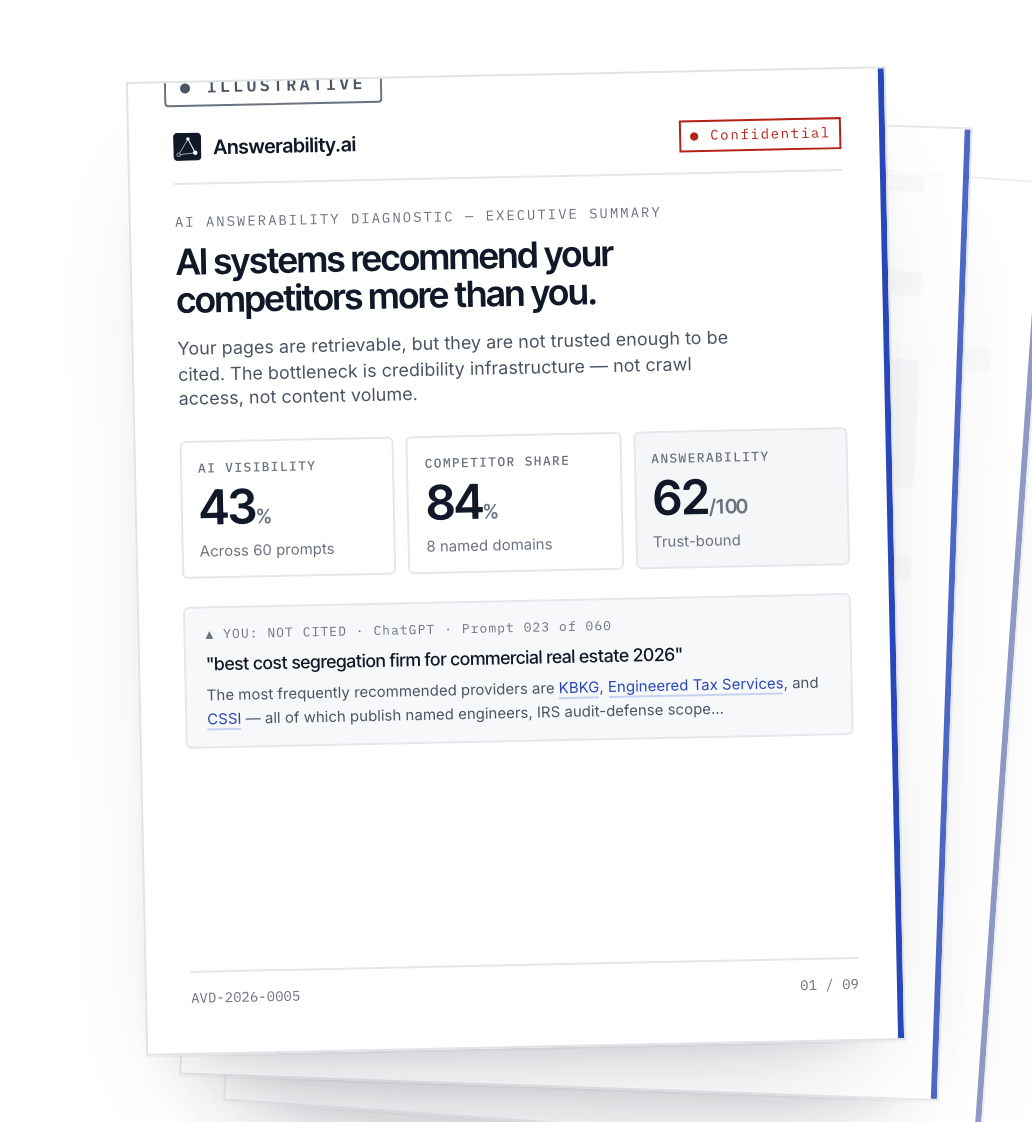
The deliverable is a long-form report, not a login — roughly fifty pages, built to be read by a leadership team and argued with, not opened once and lost in a tab. Inside: how each of the five engines answered, which competitors got named instead of you, every cited URL scored, a set of scoped fixes, and a re-audit at day 90 so progress is something you measure rather than assert.
Do you actually need one?
Most "what is this" articles end by insisting you need the thing they're selling. We'd rather be useful. A diagnostic earns its fee when buyers research you through AI before they ever make contact, when you've watched a competitor get named in an answer you were absent from, or when you're about to buy a monitoring subscription and don't yet know if you have a problem worth tracking. If you already know exactly what's broken and just need it built, you want execution, not a diagnosis — and we'll tell you so.
"Are we visible in AI?" is the wrong question. The right one is: which of the five is wrong about us, and why.
Find out what the engines say about you
If a sentence up there described your week, this is what we do: a $2,500 report — five engines, your real buyer questions, every cited URL scored — that then continues monthly at $950, cancel anytime. Confidential under MNDA.
References
- Google AI Overviews coverage of search queries (industry reporting, 2026). See Semrush, "AI Search Trust Signals" (2026).
- Affluent households beginning advisor search inside AI tools (2025 study, cited in financial-services coverage). See WealthManagement.com, "The AI Search Reckoning in Financial Services" (2026).
- Citation overlap between engines (analysis of ~680M citations): only ~11% of ChatGPT-cited domains also cited by Perplexity. See Averi, AI search visibility analysis (2026).